



Share This Post:
Thank you to our guest contributor, Morris Lilienthal of Martinson & Beason, P.C., for this primer on the various types of homeowners insurance.
If you’re like most people, your home is your single biggest asset. Protecting your home involves selecting one of the various forms of homeowners insurance that may be available to you. The homeowners insurance policy is an important aspect of real estate law, in the event disaster strikes or litigation results between you and your insurances company. Your policy can make a dramatic difference in what’s covered and what’s not when catastrophe strikes. A homeowners insurance policy is all about preparing for the unexpected.
The various types of policies can provide narrow or broad protection, with prices matched accordingly. The basic forms (HO-1 and HO-2) will only cover what’s specifically listed for coverage. The HO-3 takes the opposite approach, covering all perils that are not specifically excluded. If you live in a rented home, a mobile home, a condo, or an old home, you may have a specific type of policy as outlined below. Below are summaries of what might be applicable to your new home.
HO-1 – BASIC FORM
The HO-1 is the most basic and limited homeowners policy. Because of its severely limited form, it is not available in many states. Moreover, the mortgage company may not accept this form of insurance as it may insufficiently insure the property against loss. This limited homeowner’s policy covers fire, lightning, windstorms, hail, explosions, rioting, vehicles, smoke, vandalism, mischief, theft, glass, and even volcanic eruptions. Importantly, these are the express limitations of the policy; it will not cover damage unnamed in the policy, nor will it cover damage to personal items in the home.HO-2 – BROAD FORM
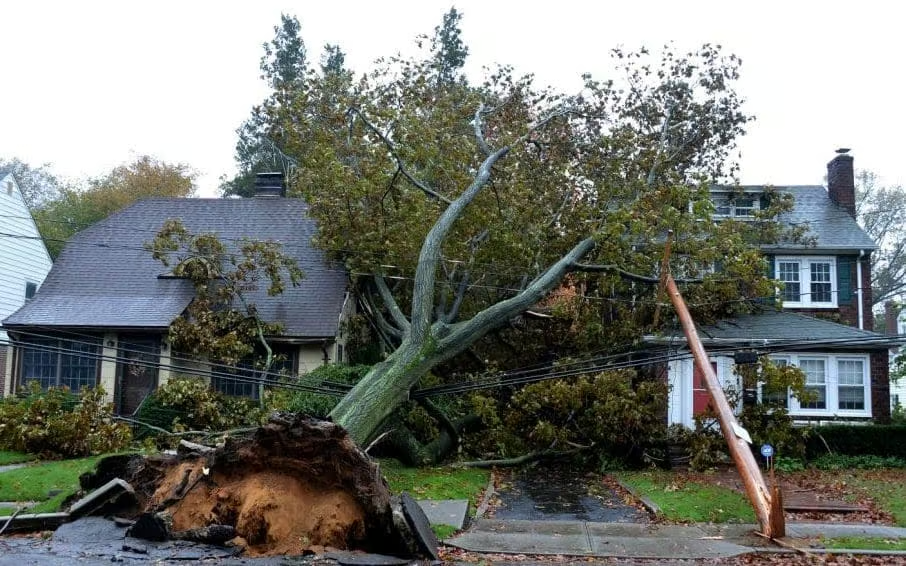
This is a slight expansion of the HO-1. This is the most basic policy in states that no longer allow HO-1 homeowners insurance. In addition to the perils covered in a HO-1, HO-2 also covers damage from falling objects like tree limbs, water damage from plumbing, heating and air-conditioning units, and household appliances. Unlike in HO-1, personal property is covered under HO-2. The HO-2 Policy only covers what’s specifically listed in the policy; unnamed perils are not covered.HO-3 – SPECIAL FORM
The HO-3 is the most common policy as it offers a broad range of protection for a reasonable price. As such, it is the preferred policy for homeowners. The HO-3 covers all the perils specifically listed under HO-1 and HO-2, but also covers most other perils that are not specifically excluded. In most HO-3 policies, earthquakes, floods, and landslides are not covered. Damage to personal property is only covered for the specific perils listed under HO-2.HO-4 – TENANT’S FORM
This policy is known as renters’ insurance because it covers the personal property inside of a rented home or apartment. Renters’ insurance becomes important particularly when the renter has expensive furnishings or other valuable goods. Renters’ insurance also provides an allowance to the renter in the event the rental house is damaged beyond occupation. Although the landlord’s policy will cover damage to the physical structure, the personal belongings of the tenants are not covered.HO-5 – COMPREHENSIVE FORM
This policy is one of the most comprehensive plans available to most homeowners with broad and deep coverage. The HO-5 homeowners policy is similar to the HO-3 in that it also covers specifically listed and most other perils, but the HO-5 is more comprehensive in that it covers damage to personal property to almost every peril.HO-6 – CONDO FORM
Even though condos are generally treated as single family dwellings, the insurance policy differs slightly. The HO-6 policy is a form of homeowners insurance designed for condominium owners. Because each condominium association has a different insurance plan in place, you have a right to inspect the policy. An HO-6 policy is need for condo owners to protect their assets within the condo, as each condo owner owns his or her own unit.HO-7 – MOBILE HOME FORM
As the name suggests, a mobile home policy, or MHP, is specifically for owners of mobile homes. It covers the specifically listed perils of a HO-1, but may also have additional coverage akin to what is offered in the HO-3.HO-8 – OLDER HOMES
This homeowners insurance policy is known as an “older homes” policy, as it is tailored specifically to old homes. The HO-8 policy is particularly useful for making replacements and repairs that exceeds the market value of the home. These policies usually are available for home 40 years or older that do not qualify for an HO-3. Thank you Morris, for this insightful post and wealth of information! As always, if we can help you with any of your real estate needs, please reach out. We are always happy to help! For more articles like this one, sign up for our weekly blog roundup.Newsletter Signup
"*" indicates required fields
Looking For Additional Resources?
We’ve got you covered. Click the button below to download our lifestyle, real estate, and area guides.
Get Our Guides